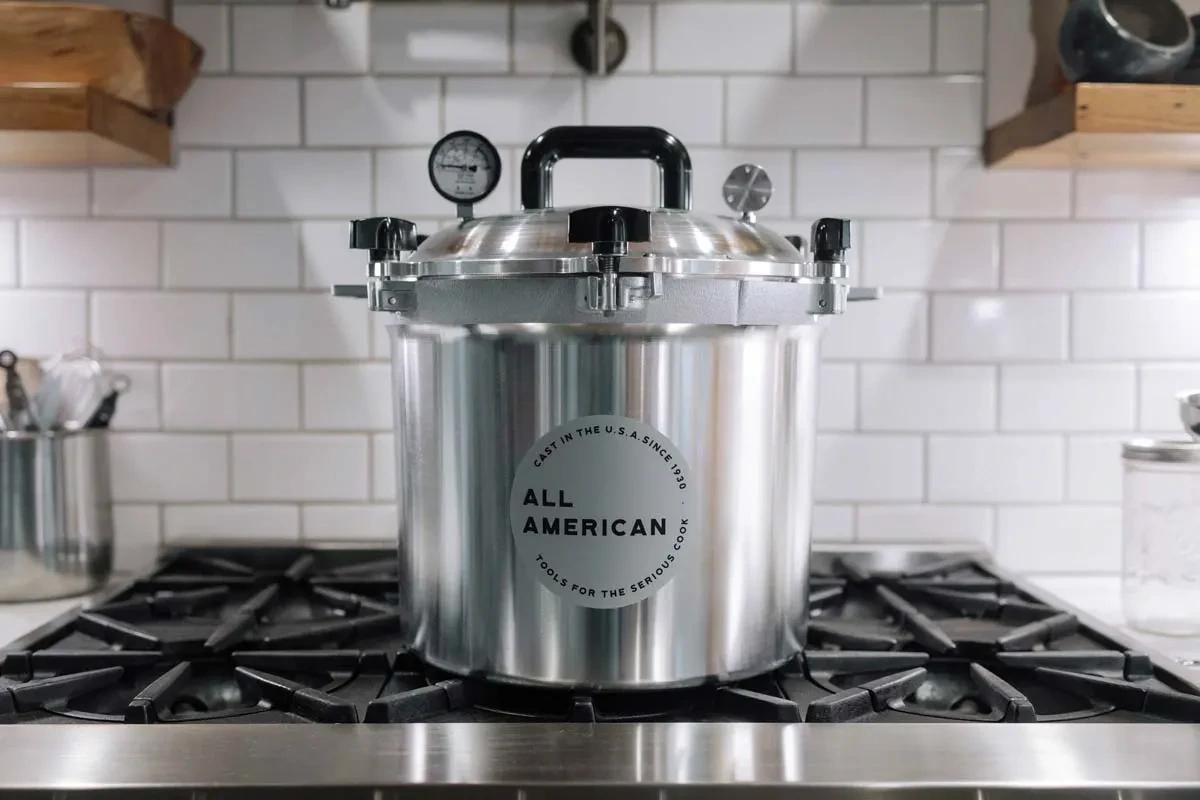
Pressure canner weighted gauge
The only safe way to can green beans, soup and meat at home. A weighted-gauge canner never needs its gauge tested, and this one has no gasket to wear out.
One 22 qt aluminum pressure canner with a three-setting pressure regulator, a reference gauge and two racks; holds 7 quart or 18 pint jars, per the listing. Pictured, the All American 921; the T-fal is a different canner.
We earn a commission if you buy through these links, at no cost to you.
- 7 quartsor 18 pints a load, per the 921 listing
- 5 / 10 / 15 psithree-way weighted regulator
- No gasketmetal-to-metal seal, per the 921 listing
- No testinga weighted gauge needs no yearly check (USDA guide)
“Buy the canner that still works when there is nobody around to test your gauge.”
Vegetables, beans, meat, poultry and soup are low-acid foods. The USDA publishes no boiling-water process for them; they need the 240 to 250 F that only a pressure canner reaches. A pressure cooker without a gauge, a slow cooker or an oven is not a substitute.
A weighted gauge is the one to own for a long emergency: the weight holds the pressure and needs no yearly testing, where a dial gauge drifts and has to be checked at an extension office. The All American 921 adds a metal-to-metal seal, so there is no rubber gasket to crack in storage. It holds seven quart jars a load, and it doubles as a water-bath canner.
Other models
How to use it
- Put 2 to 3 in of water in the canner, heat it, and load the hot filled jars on the rack.
- Lock the lid and leave the vent open until steam flows steadily, then let it vent a full 10 minutes.
- Put the weight on at your altitude's setting: 10 lb at 0 to 1,000 ft, 15 lb above that (USDA guide).
- Start timing when the weight starts to jiggle or rock, and hold that for the whole time. If it stops, bring it back up and start the time over.
- Turn off the heat and let the canner cool on its own. When pressure is at zero, remove the weight, wait 10 minutes, and open the lid away from your face.
- Lift the jars out and leave them undisturbed for 12 to 24 hours, then check the seals.
Photo: Nutrition, Food Safety & Health (Flickr), CC0. Credits