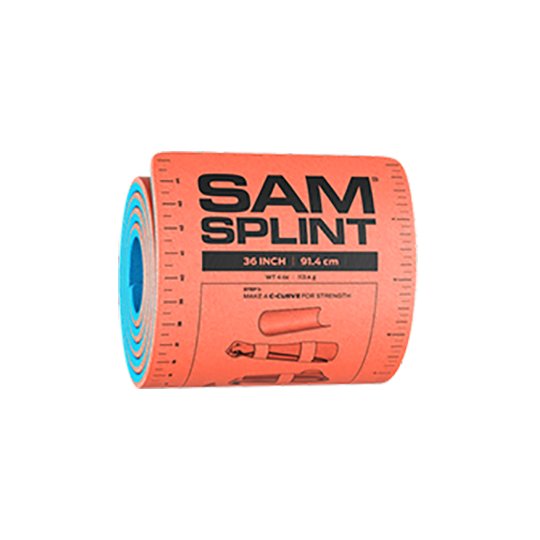
Moldable aluminum splint 36 in
Rated 4.8 out of 5: 4.8 · 3,307 ratings
One flat roll in the kit becomes a padded, rigid splint for an arm, a wrist or an ankle, shaped by hand.
One SAM Splint, 36 in by 4.25 in, rolled, orange and blue (SP506-OB-EN)
We earn a commission if you buy through these links, at no cost to you.
Manuals and documents
- 36 inby 4.25 in wide, rolled flat for the kit
- C-curvebend it and it gets stiff, per SAM Medical
- Scissorscut it to size with ordinary scissors
- Reusablebend it back flat and use it again
“A board and a roll of tape will do. This is lighter, padded, and already in the kit.”
When help is hours away, a suspected break or bad sprain has to be held still before anyone moves. A splint keeps the broken ends from moving, which stops pain, bleeding and further damage. A board, a rolled magazine or a folded blanket will do it. The SAM Splint does it lighter and faster to shape.
It is a thin sheet of aluminum sandwiched in closed-cell foam. Flat, it is floppy. Bend a curve into it along its length and, by SAM Medical's description, it becomes stronger and more supportive, strong enough to support an injured limb with a wrap or tape. It cuts with ordinary scissors, and straightens out to use again. The 36 inch roll is 4.25 inches wide and lies flat in a kit. Keep two, with two finger splints.
A splint is first aid, not treatment. Any suspected fracture, open fracture or dislocation needs professional care if any can be reached.
How to use it
- Stop any bleeding first. Do not straighten the limb: splint it in the position you find it (Red Cross; Hesperian).
- Check the fingers or toes beyond the injury: color, warmth, feeling and movement. Write down what you find.
- Bend a curve along the splint's length to stiffen it, and shape it to the limb.
- The splint must cross the joint above and the joint below the break. Pad bony points.
- Wrap it on firmly, above and below the break, never directly over it, and leave the fingers or toes uncovered.
- Check the fingers or toes again right away and often. If they turn cold, pale, numb or more painful, loosen the wrap.